


Seven years. Eleven cohorts. Thirty-seven products. What the SIDFS Product Innovation Lab learned about turning financial inclusion policy into things people actually use.
Nigeria’s exclusion problem has never been a shortage of policy. We have had a National Financial Inclusion Strategy since 2012, revised twice. We have a regulatory sandbox, agent banking guidelines, a collateral registry and a digital finance policy. What the market has lacked, consistently, is institutions with both the method and the incentive to design for low-income customers.
The consequence is a gap that policy alone cannot close. Roughly 38 million Nigerian adults, about 26% of the adult population, sit entirely outside formal and informal finance. Exclusion is deepest among women, rural households, youth and informal workers. In parts of the North-West and North-East, female exclusion runs past 60%. Mobile money boomed in the cities and barely registered in the villages.
The Product Innovation Lab was built in 2019 by the Sustainable and Inclusive Digital and Financial Services (SIDFS) initiative of Lagos Business School to work in exactly that gap: the place where a policy target becomes a product brief, a design sprint, a pilot, and eventually a customer.
Not a research programme. A workshop.
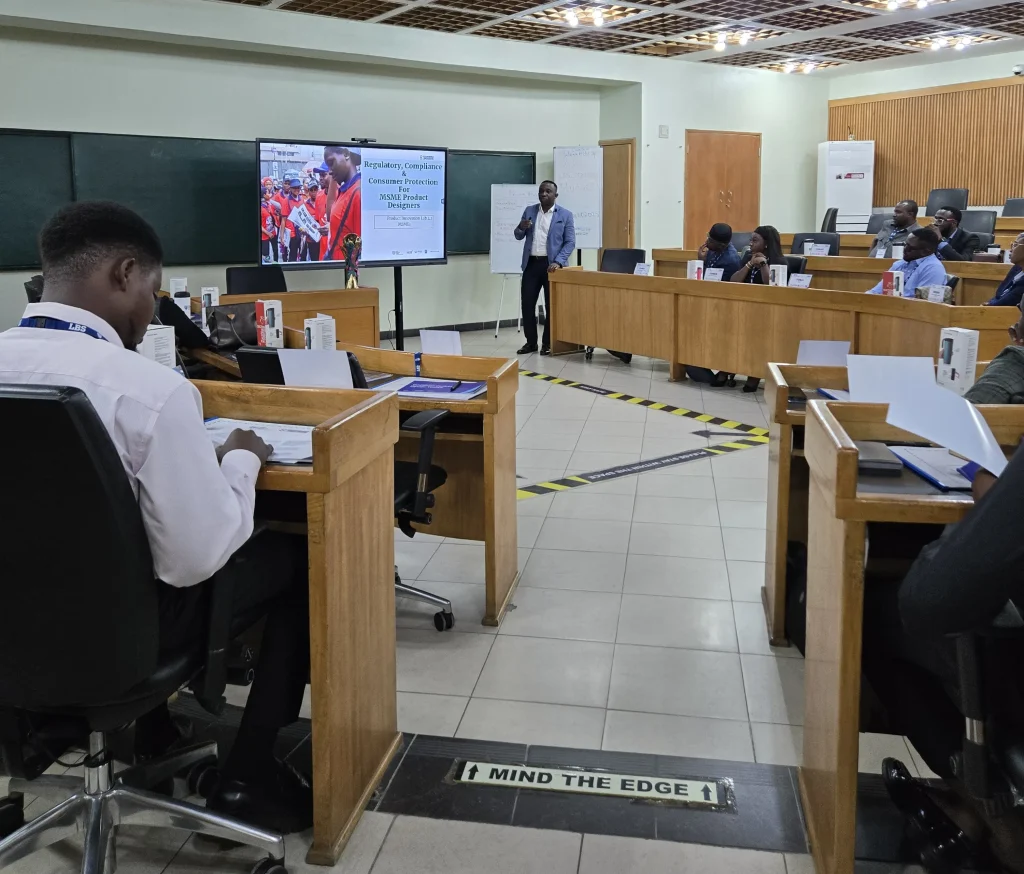
The Lab does not publish recommendations and hope someone acts on them. Financial institutions bring a real product idea. SIDFS supplies human-centred design methodology, market research, regulatory guidance, mentorship, and a room full of peers who are usually competitors.
Every product carries one non-negotiable requirement: it must name the NFIS target it serves. No inclusion language without an inclusion mechanism.
The arc, and the useful failure at the start
The first four cohorts ran virtually as the Product Development Lab. Thirteen organisations, thirteen products, three of which reached market. That early result was the most instructive moment in the Lab’s history, because it told us precisely what determines whether an inclusive product ships: a named executive champion, budget committed before the sprint rather than after it, and a short runway from design to pilot.
Rebuilt on those lessons as the Product Innovation Lab, the next cohort launched all four of its products. Seven PIL cohorts have followed, adding dedicated programmes for women, for MSMEs, and for Northern Nigeria, the region with the country’s deepest exclusion and the least fintech attention.
The portfolio now stands at 37 products, 21 of them in market.
What is in the market
The list is deliberately unglamorous, which is the point.
Her Mata (Lotus Bank) built Sharia-compliant finance for Muslim women shut out of conventional banking, grounded in real ethnography rather than assumption. Ajo Savings (Wema) and EsusuPay (Esusu Africa) digitised rotating savings traditions instead of trying to replace them, and are now cited as models for culturally grounded inclusion in West Africa. Kidashi (Xchangebox) runs women’s trust circles over USSD with MTN in Kano, no smartphone required, which is precisely the point in Kano.
Alongside them: inventory credit for medicine sellers through Tillit’s Order Sharp Sharp, collateral-free lending to women-led MSMEs through Grooming MFB’s Beta Moni, savings-to-own asset finance through Lendha’s Beta Life, community health cover through Iyewo Clinic’s Micro Health Insurance, and goal-based family savings through Regxta’s My Family & I Savings.
More than ₦2.5 billion in credit has reached MSMEs and women through Lab products. Regxta has passed 25,000 customers, growing at 400%. Of HerMoni’s borrowers, 98% are women, most of whom previously borrowed from moneylenders at punishing rates. Iyewo’s micro health insurance saw more than 600 sign-ups in its first phase, in a country that spends roughly 0.5% of GDP on health insurance.
These are no longer pilot numbers. They are people with credit histories, insurance cover and savings records who did not have them before.
What changed inside the institutions
Every participating institution went through structured human-centred design: ethnographic research, problem framing, prototyping, market testing. For most Nigerian financial institutions this is a departure, because product development has typically followed technology availability or compliance deadlines rather than customer insight.
The method travelled. Institutions report applying it well beyond their inclusion products, and several banks have since stood up internal design functions. As one participating institution put it, the process forced them to validate assumptions before building, and what they discovered was that what they thought customers wanted and what customers actually needed were fundamentally different.
Five things seven years taught us
- A named senior champion is the strongest single predictor of success. Products managed at operational level stall. Products with an executive ownership.
- Commit budget and staff time before the sprint, not after. Resource pre-commitment cuts post-lab attrition sharply.
- Six months is the window. Products that move from design to pilot within half a year succeed far more often than those deferred.
- Settle the regulation at design stage. Products built with active regulatory engagement launch more reliably than those that meet compliance late.
- Cultural alignment is not a nice-to-have. Products that build on indigenous mechanisms such as Ajo, Esusu and trust circles consistently out-adopt products that import a foreign financial model wholesale.
None of these findings is surprising in isolation. What the Lab supplies is evidence that they hold across eleven cohorts, seven years, and every institution size in Nigerian finance.
What comes next
The work is not finished. Thirty-eight million adults remain unbanked. The gender gap persists. Agricultural finance is still inadequate, insurance still negligible, the North still behind. None of the structural drivers of exclusion have been removed. They have been addressed in specific places, by specific products.
Programmes of this kind typically need five to seven years to reach methodological maturity. The Lab is arriving there now, which makes this the moment when investment compounds fastest.
The question is no longer whether the model works. It is how fast it can be scaled.
The full Product Innovation Lab Impact Report 2019 to 2026 covers all eleven cohorts, the 21 launched products, the customer impact data and the seven recommendations for what comes next. Prepared by the SIDFS team, Lagos Business School.